

Overview
This tutorial shows you how to streamline the employment contract process by automatically sending, signing, and storing contracts. By integrating Microsoft Forms (for data collection), OneDrive (for storing contract templates), and the SignatureAPI connector (for electronic signatures), you can eliminate manual errors and delays when onboarding new employees.What You’ll Learn
- How to trigger a flow with a new Microsoft Forms response.
- Retrieving and pre-filling a DOCX contract template from OneDrive.
- Creating and sending a signature envelope using SignatureAPI.
- Monitoring the signing process and retrieving the signed document.
- Saving the signed contract and notifying HR automatically.
The Problem
HR departments often struggle with manually handling contracts, causing delays in onboarding. Common issues include:- Slow processing that delays new hire start dates.
- Errors from manual data entry across multiple documents.
- Tracking difficulty when monitoring signing status across teams.
How Automation Helps
Automation simplifies this process by:- Automatically sending contracts upon form submission.
- Using templates pre-filled with employee details.
- Tracking signature status and storing documents automatically.
- Informing HR instantly once contracts are signed.
Requirements
Before starting, make sure you have:- Power Automate to build workflows.
- SignatureAPI account for electronic signatures.
- Microsoft Forms for collecting employee information.
- OneDrive for storing your DOCX templates.
- Outlook for sending notifications (other email providers also work).
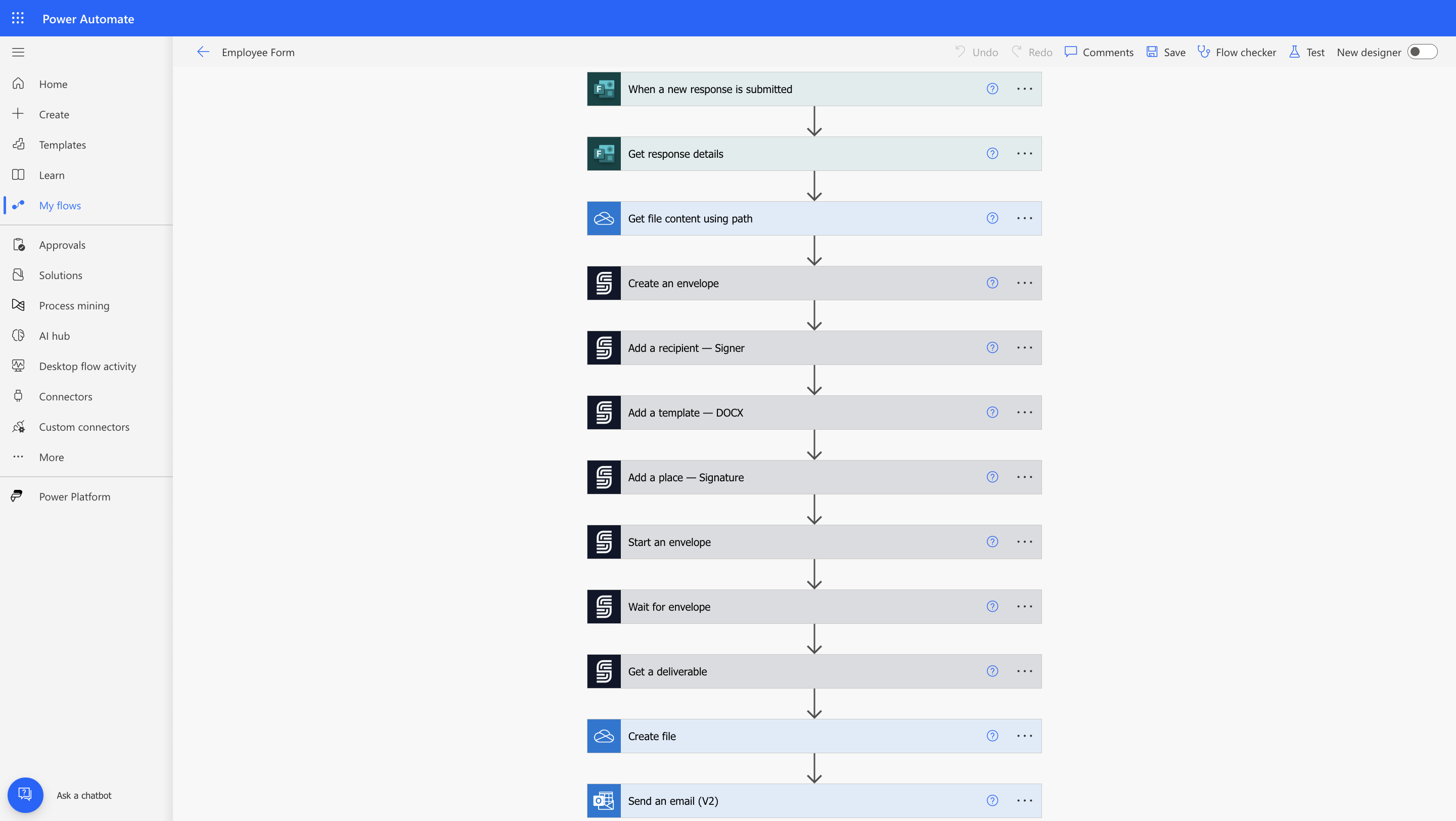
Flow Overview
The automation process follows these steps:- Trigger: Microsoft Forms submission starts the flow.
- Data Retrieval: Get employee details and fetch the contract template from OneDrive.
- Signature Process: Create an envelope via SignatureAPI, add recipient details, and attach the DOCX.
- Monitoring: Wait for the contract to be signed.
- Storage & Notification: Save the signed document in OneDrive and notify HR via email.
Step-by-Step Tutorial
Follow these steps to automate your employment contract process using Microsoft Forms, SignatureAPI, and Power Automate:Step 1: Prepare the Contract Template
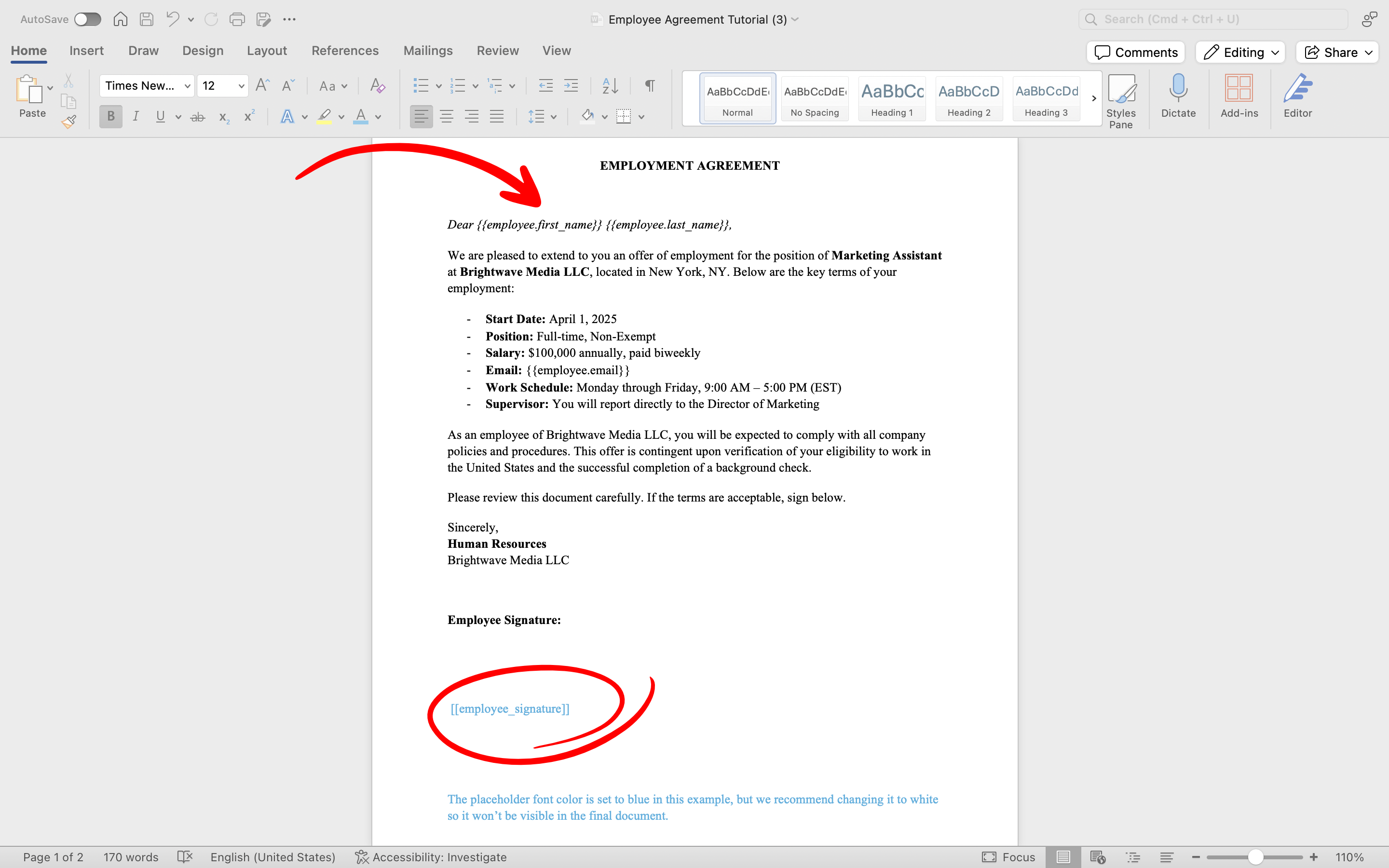
First, create or update your employment contract template by adding placeholders for dynamic fields (employee details) and defining where the employee will sign. To prepare your template:- Open your existing employment contract document (DOCX format) in Microsoft Word.
- Identify each place where employee details should be dynamically inserted (e.g., name, email).
- Insert placeholders using double curly brackets around descriptive keys. Examples:
- Employee first name:
{{employee.first_name}} - Employee last name:
{{employee.last_name}} - Employee email:
{{employee.email}}
- Define the location for the signature clearly by inserting a signature placeholder using double square brackets, e.g.:
[[employee_signature]]
Dear{{employee.first_name}}{{employee.last_name}}, Please review and sign your employment contract below:[[employee_signature]]
- Save your template and upload it to OneDrive (or another preferred storage service).
- Ensure placeholder keys match exactly with what you’ll use later in Power Automate.
- Keep your template simple and clear to avoid confusion during dynamic insertion.
Step 2: Create the Microsoft Form
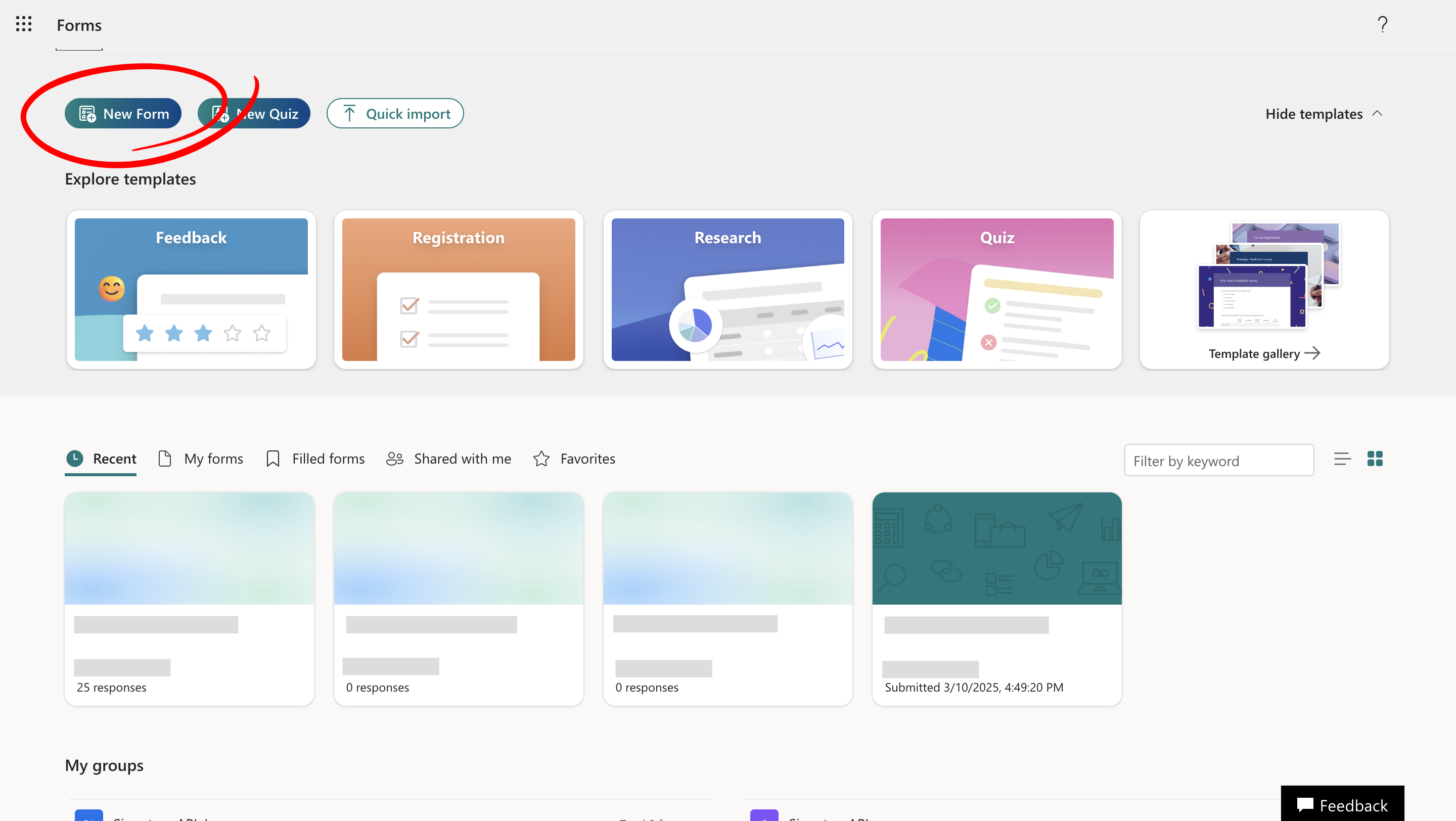
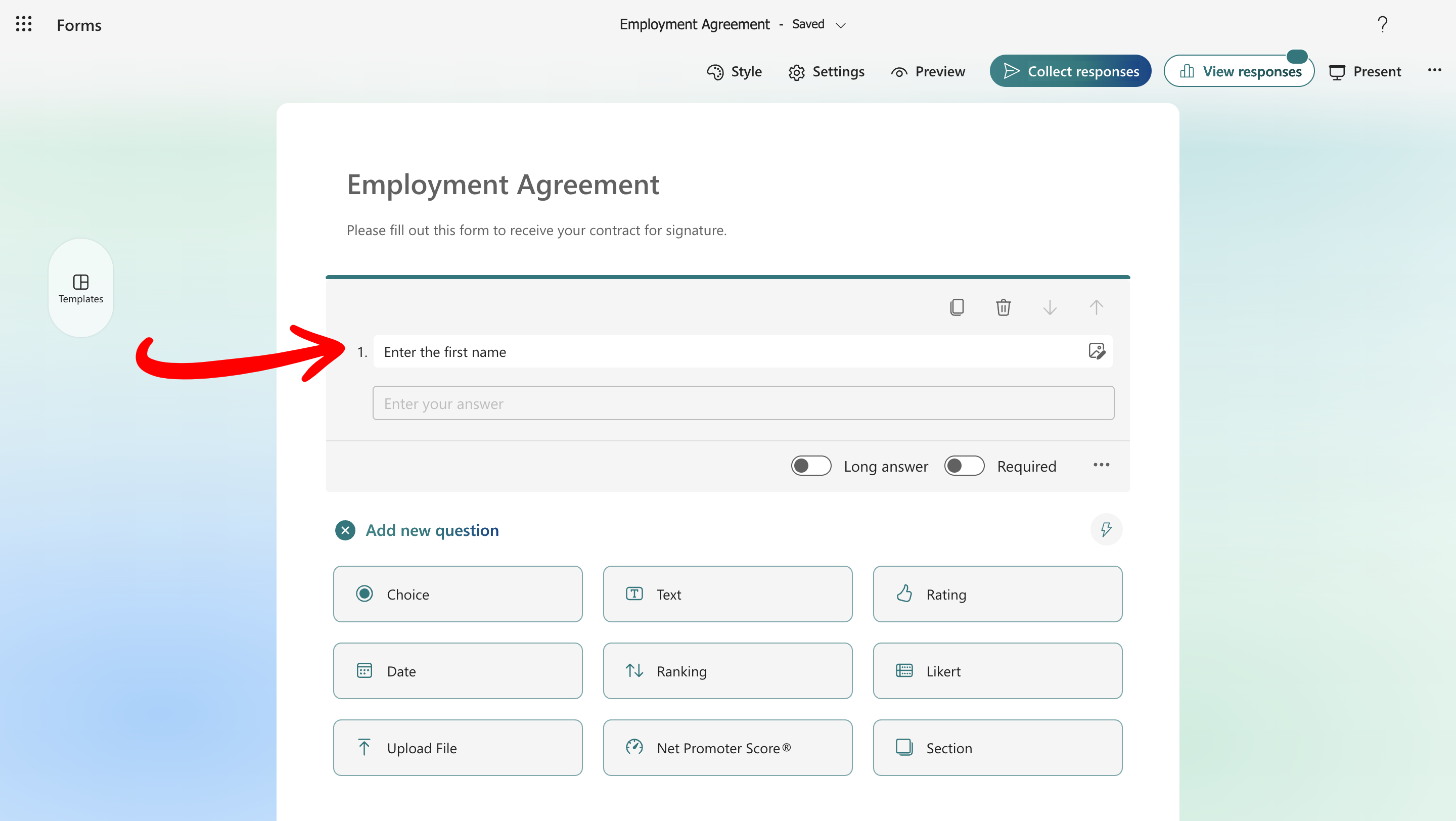
Create a Microsoft Form to collect the necessary employee details (First Name, Last Name, Email Address).- Visit Microsoft Forms and sign in.
-
Click New Form.
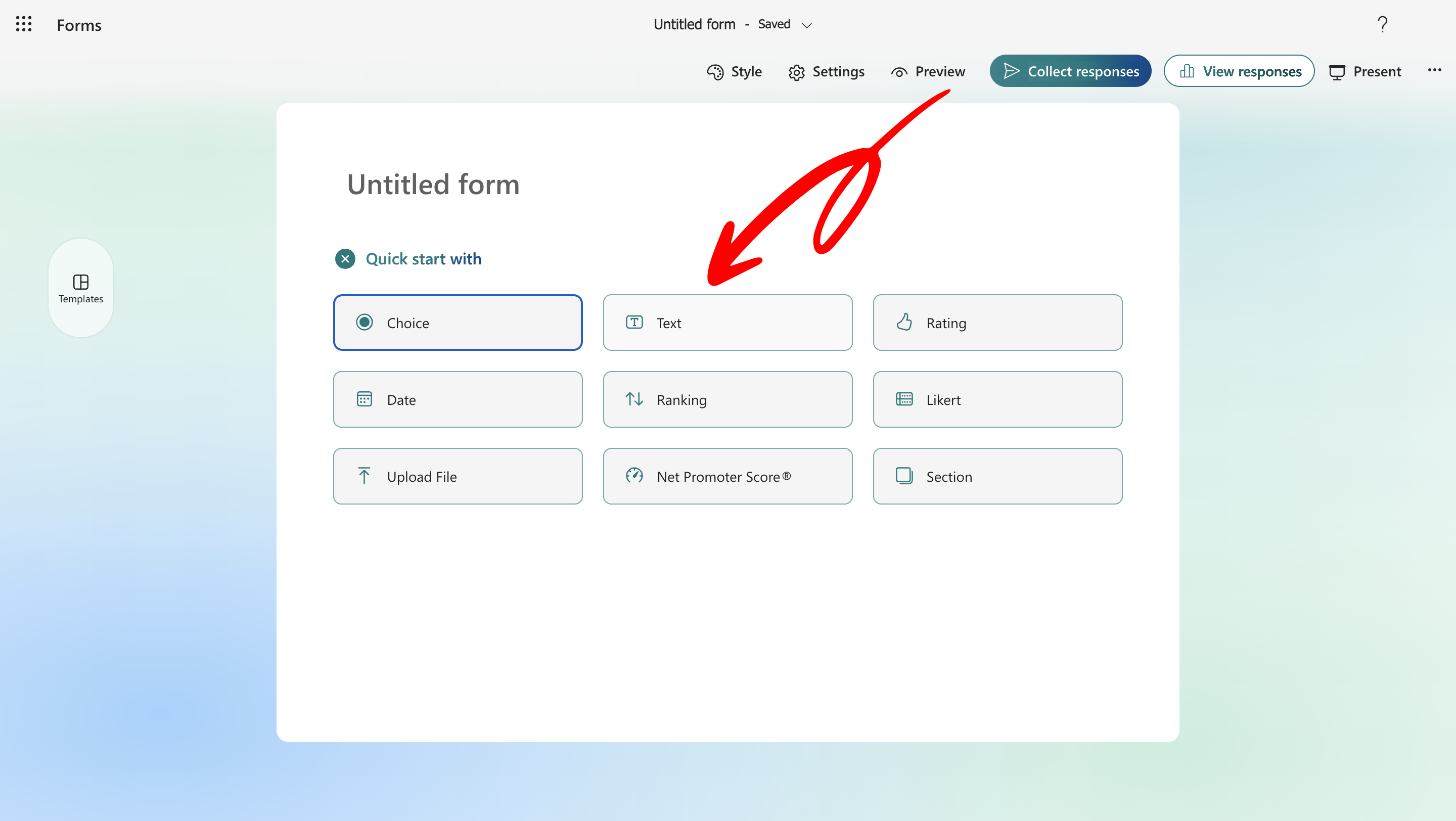
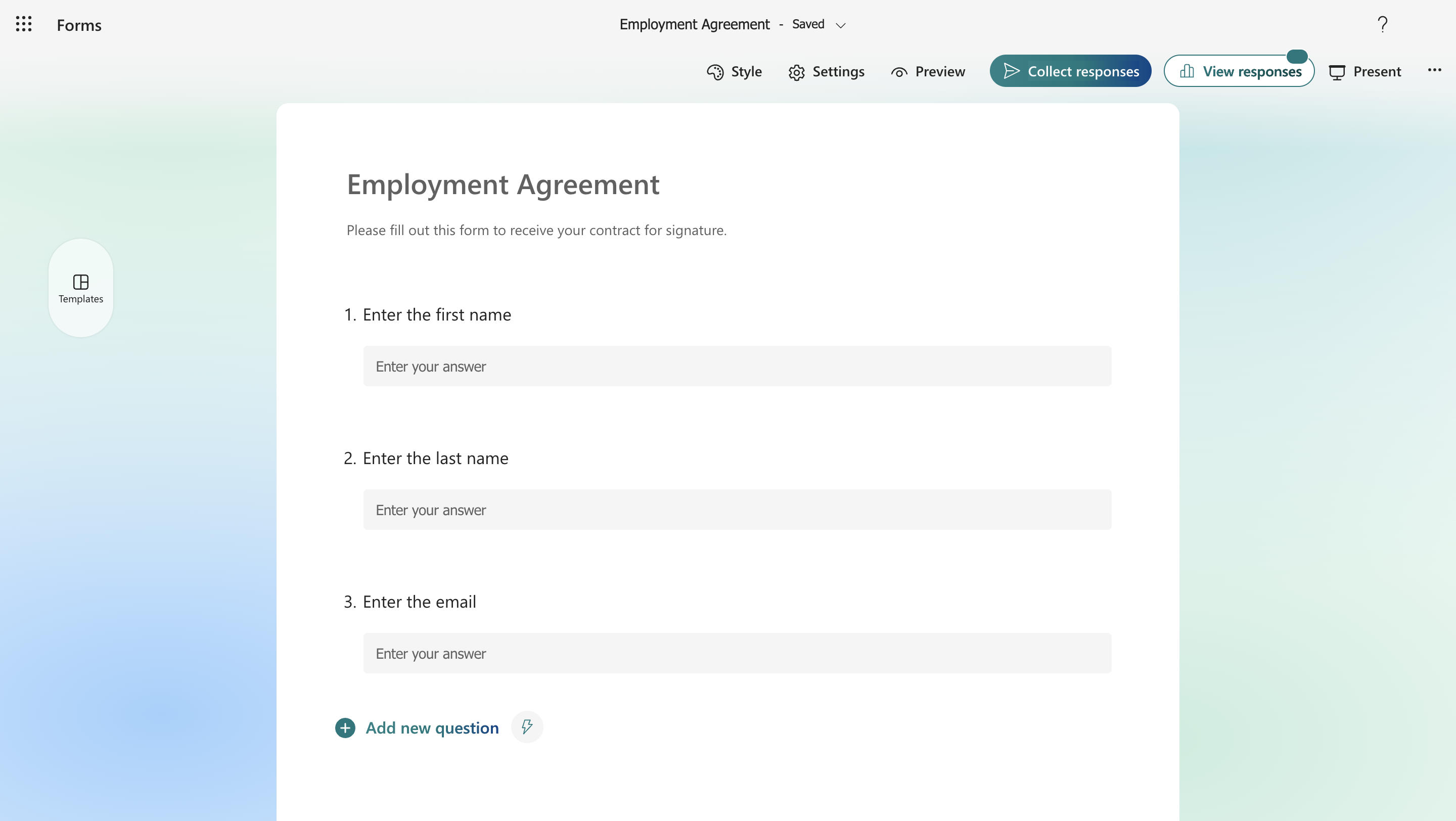
- Name the form and add these required questions:
- First Name (Text, required)
- Last Name (Text, required)
-
Email Address (Text, required)
-
Save and publish your form.
Step 3: Set Up the Power Automate Flow
Now, create the automated workflow in Power Automate, triggered whenever a form is submitted.3.1 Configure the Trigger
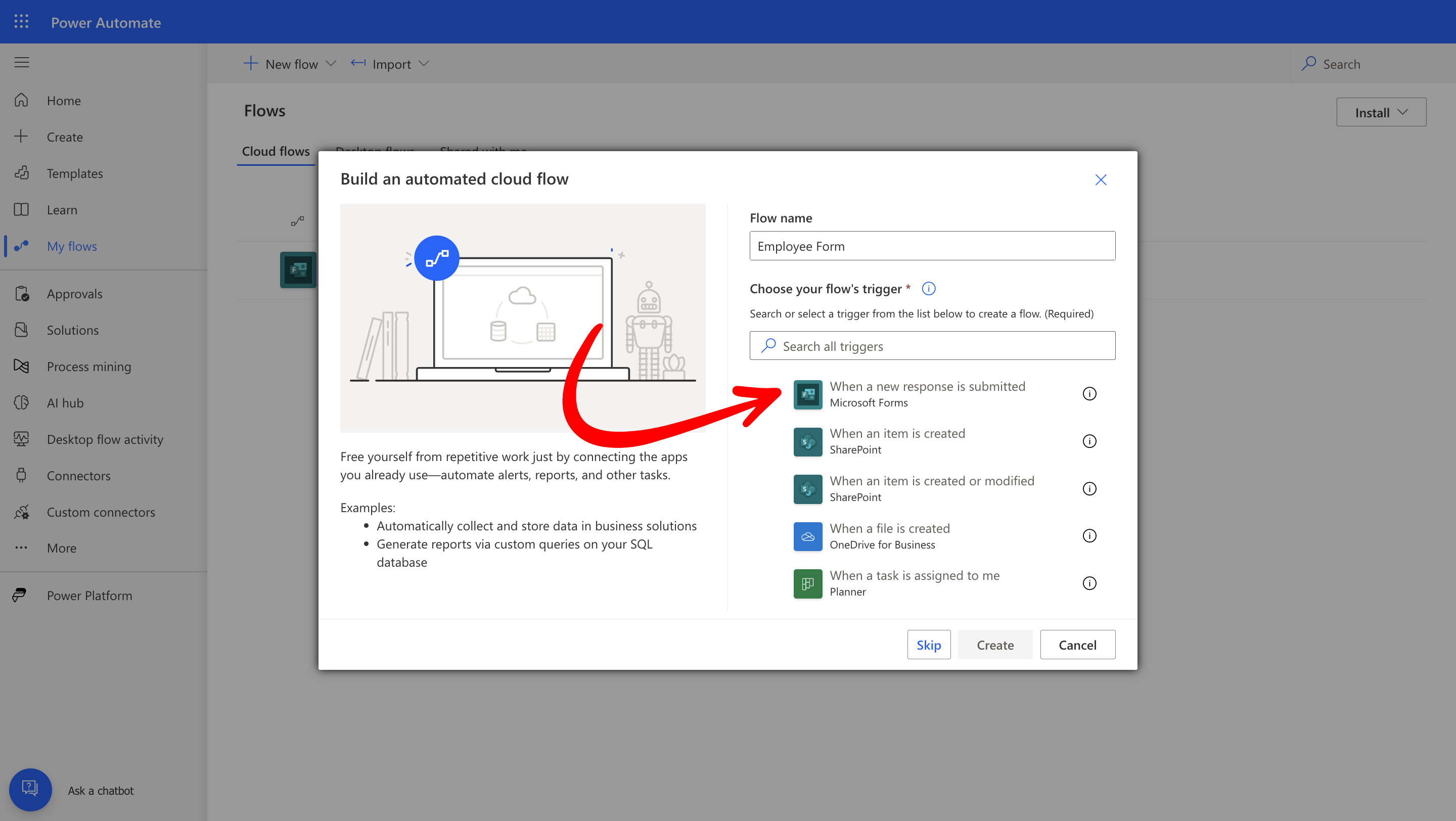
Set the flow trigger to run whenever your form is submitted.- Go to Power Automate and select Automated Cloud Flow.
-
Choose the trigger When a new response is submitted (Microsoft Forms).
-
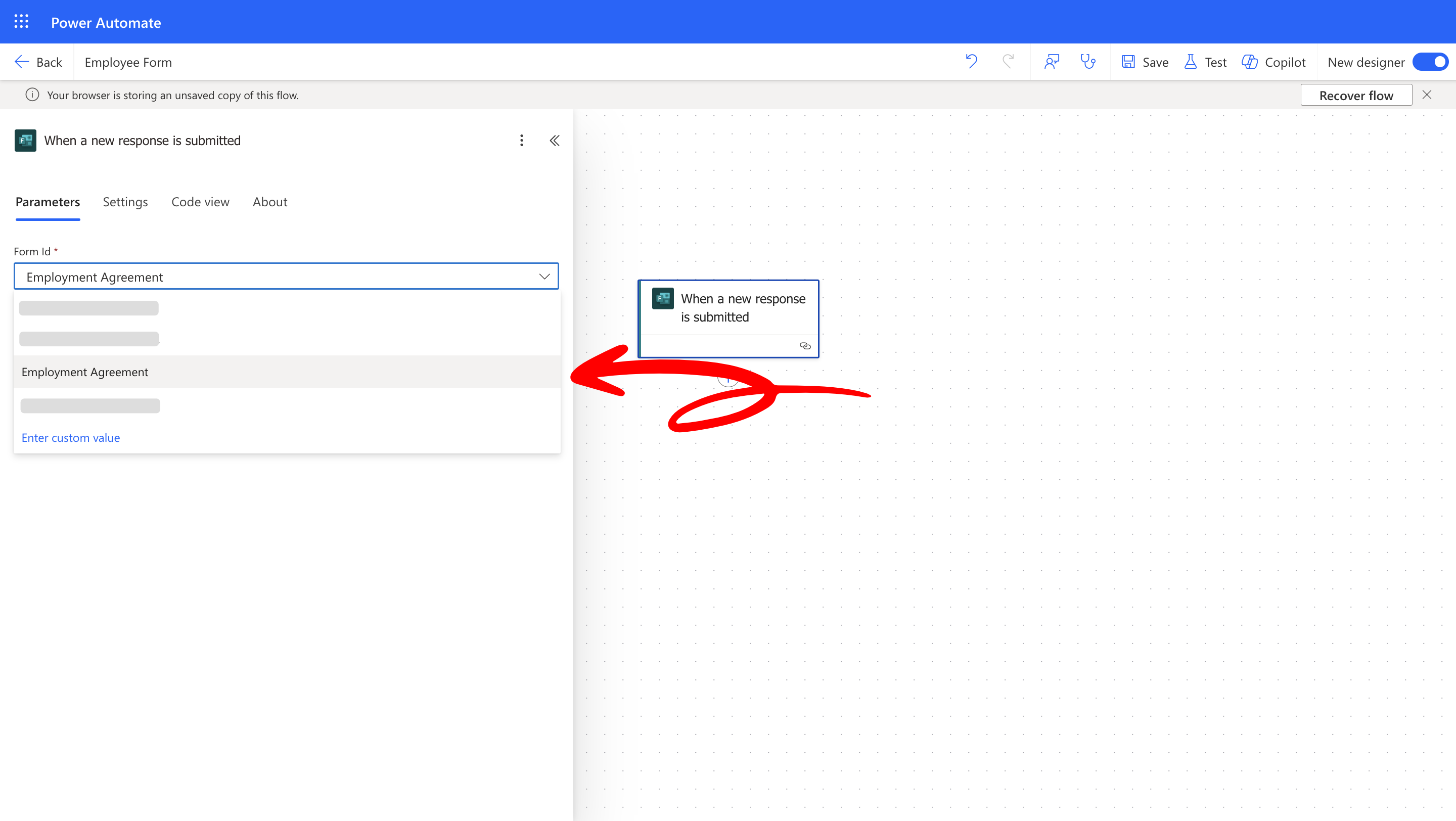
Select the form you created earlier.
3.2 Retrieve Employee Details
Next, retrieve the employee details submitted through the form.- Add the action Get response details.
-
Select your form (Form ID) and the response (Response ID) from Dynamic Content.
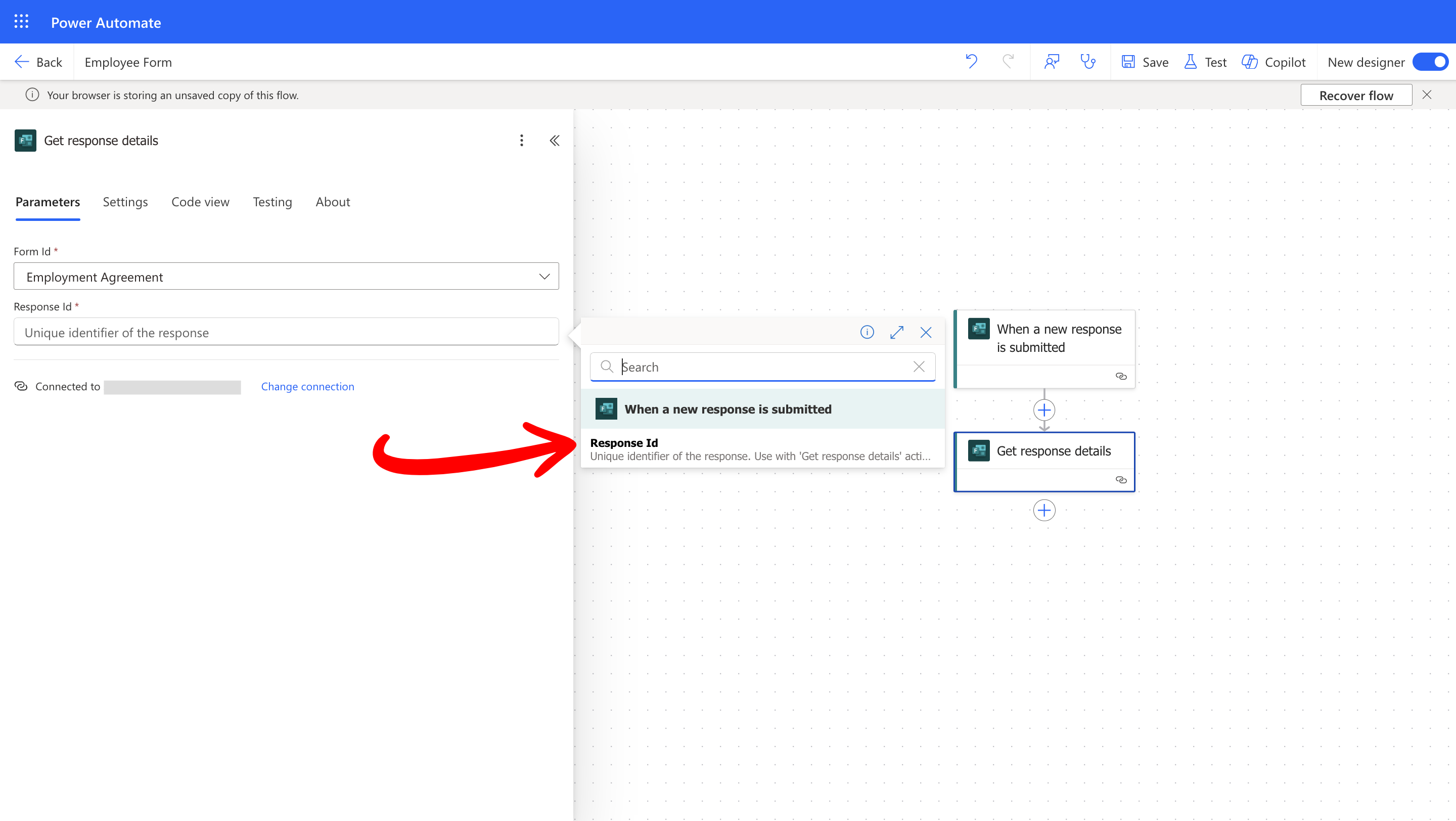
3.3 Retrieve Contract Template from OneDrive
Fetch your employment contract template stored in OneDrive.- Add Get File Content using Path from the OneDrive connector.
-
Select the DOCX template stored in your OneDrive.
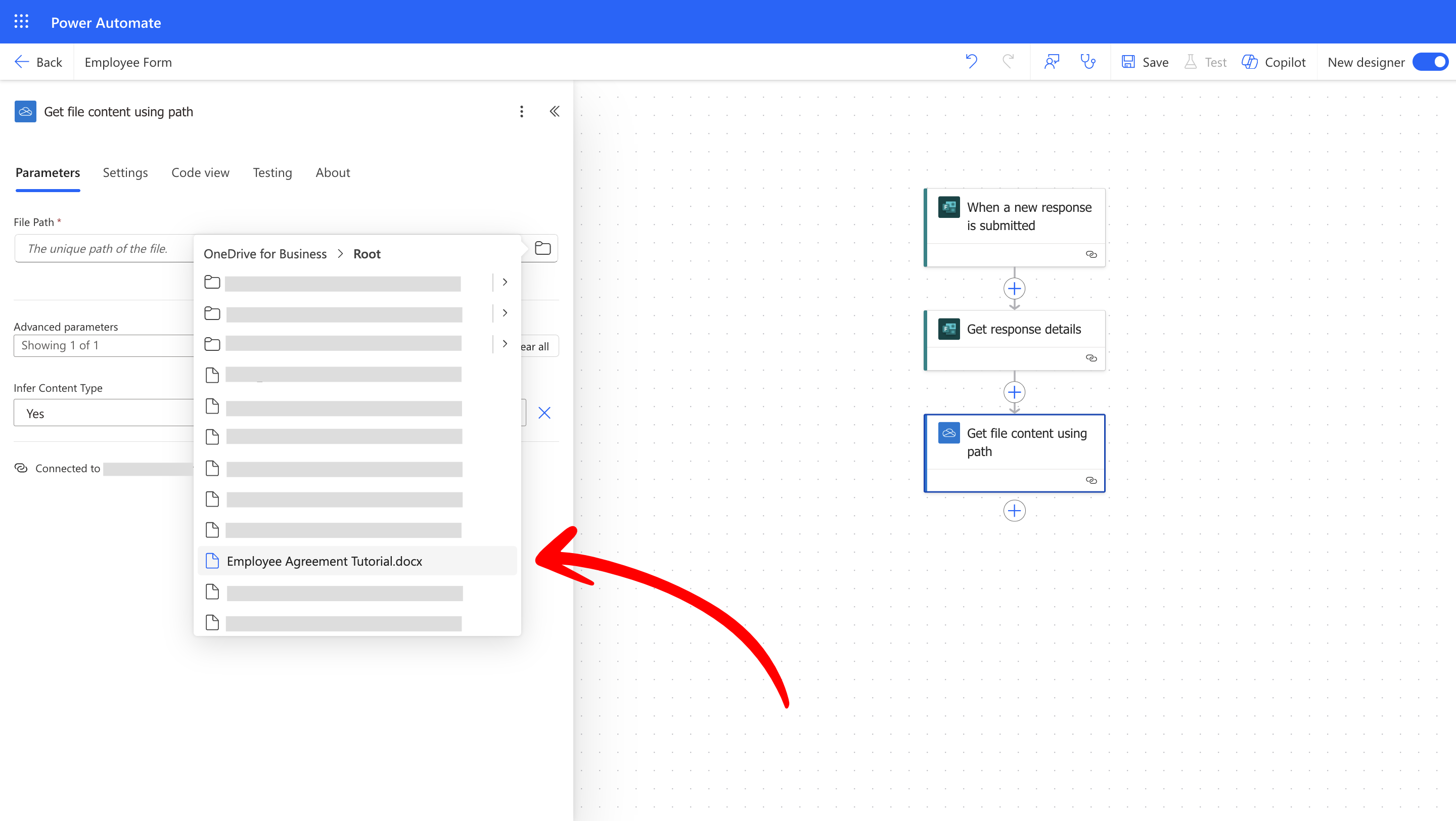
Step 4: Set Up the Signature Process
In this step, you will configure SignatureAPI to create, send, and track the signature process.4.1 Create a SignatureAPI Envelope
Begin by creating an envelope to hold your contract and signature process.- Add the Create an Envelope action (SignatureAPI connector).
- If prompted, authenticate your connection using your SignatureAPI key from the SignatureAPI Dashboard.
-
Set an Envelope Title (e.g., employee name) and email message using dynamic content.
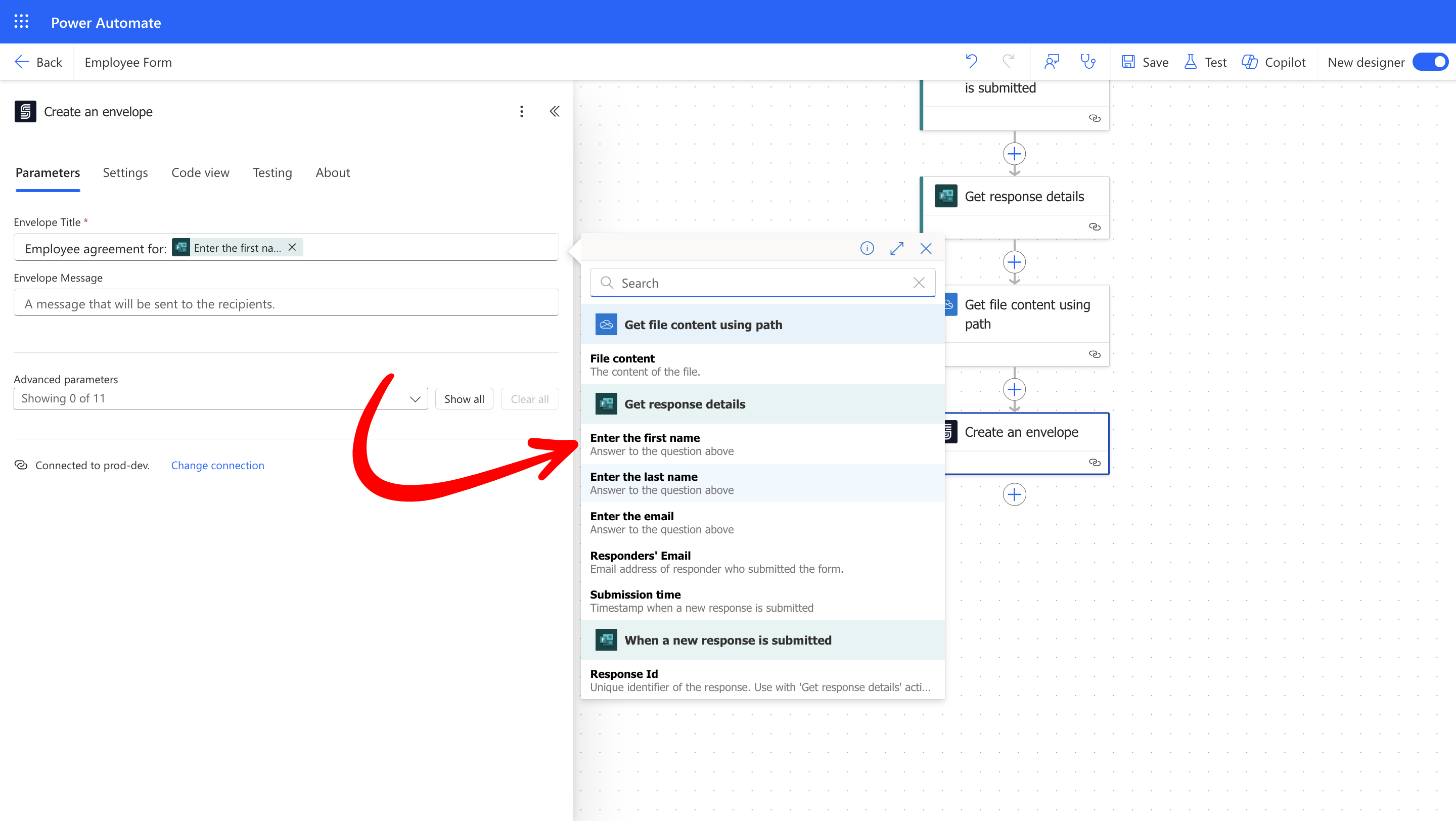
4.2 Add the Recipient
Specify who will receive and sign the contract.- Add the Add Recipient action.
- Map Recipient Name and Recipient Email using form details (Dynamic Content).
-
Set the Recipient Key (e.g.,
employee), matching your DOCX placeholders.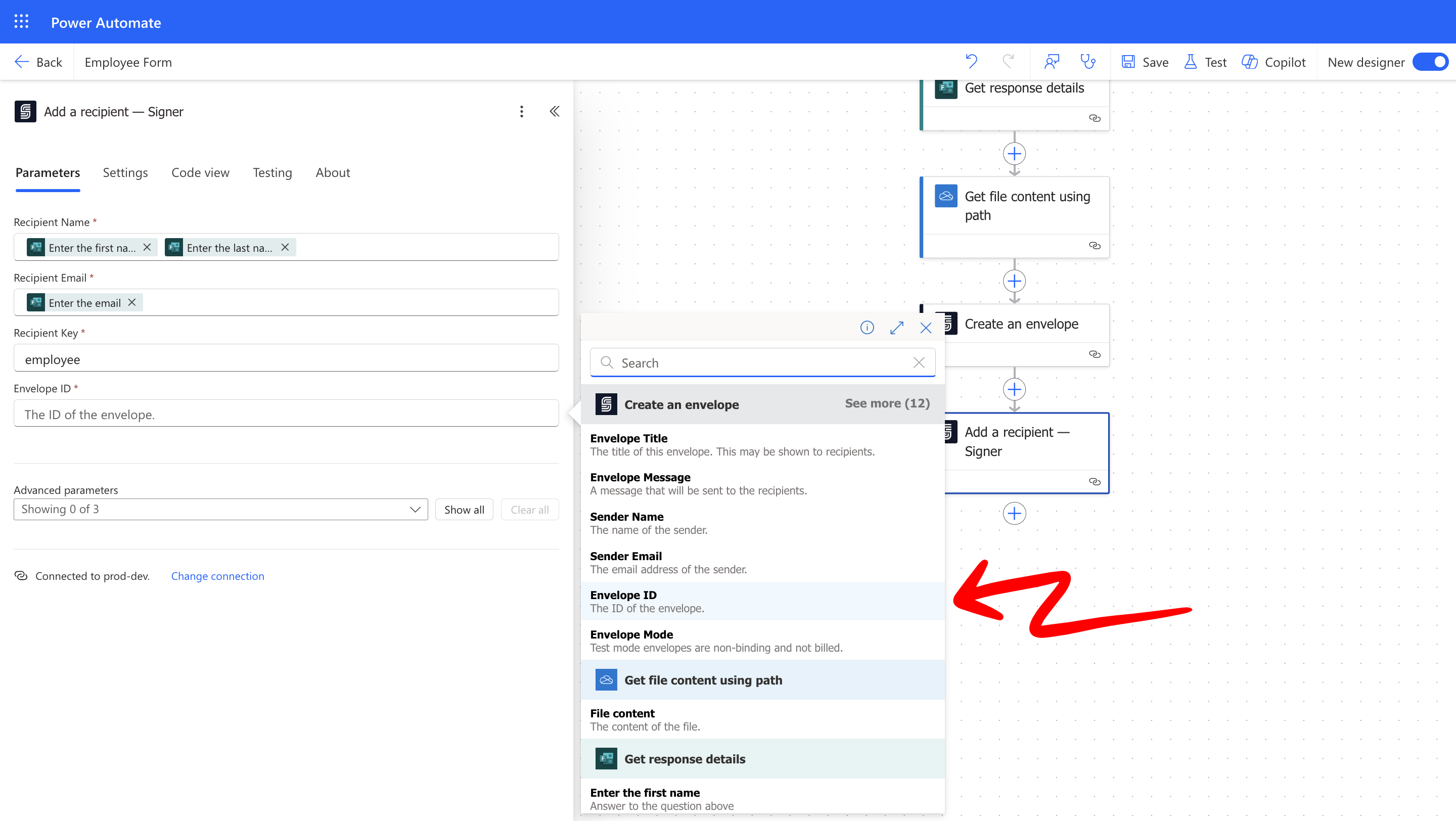
4.3 Attach the DOCX Contract Template
Attach your contract template to the envelope and populate it with employee details.- Add the Add a Template - DOCX action.
- Select File Content from the OneDrive action.
- Set the Document Title (e.g., “Employment Contract”).
-
Ensure your DOCX template uses placeholders (
{{employee.first_name}}, etc.) and map each field to the corresponding dynamic content from your form.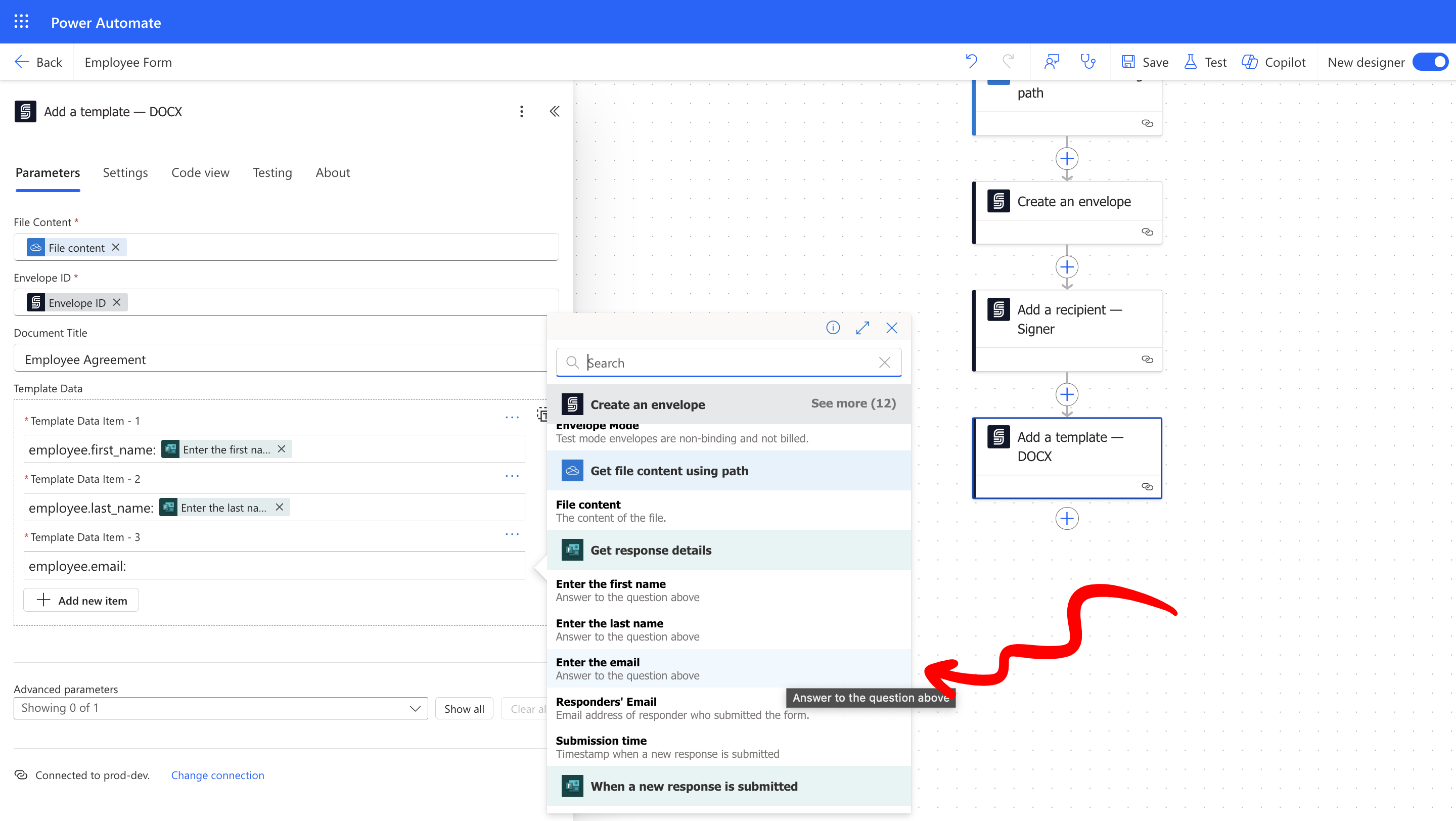
4.4 Define Signature Placement
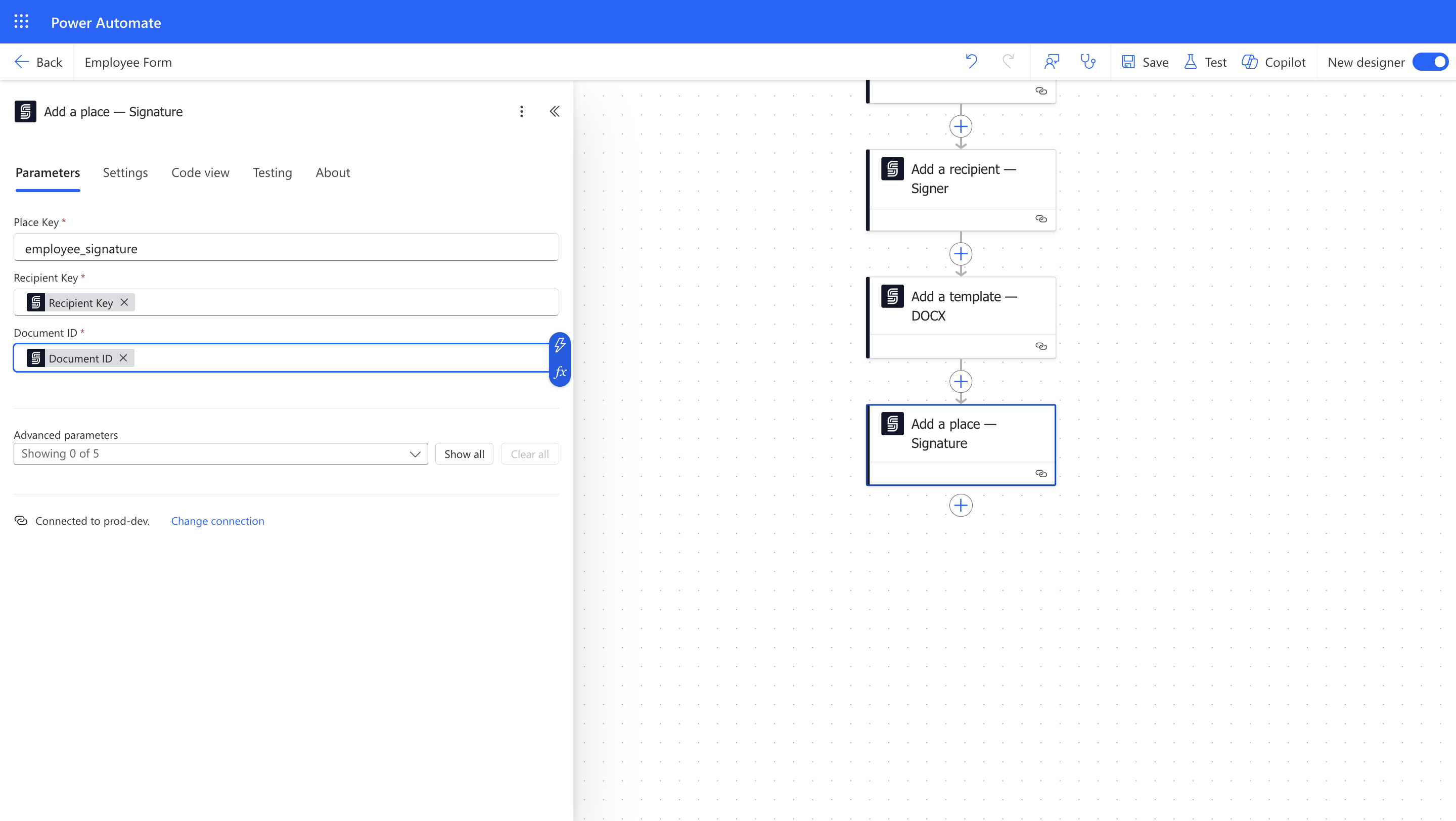
Specify where the employee should sign on the document.- Add the Add a Place - Signature action.
- Set the Document ID using dynamic content.
-
Use the placeholder (e.g.,
[[employee_signature]]) from your DOCX template. -
Set the Recipient Key using dynamic content.
4.5 Start the Signing Process
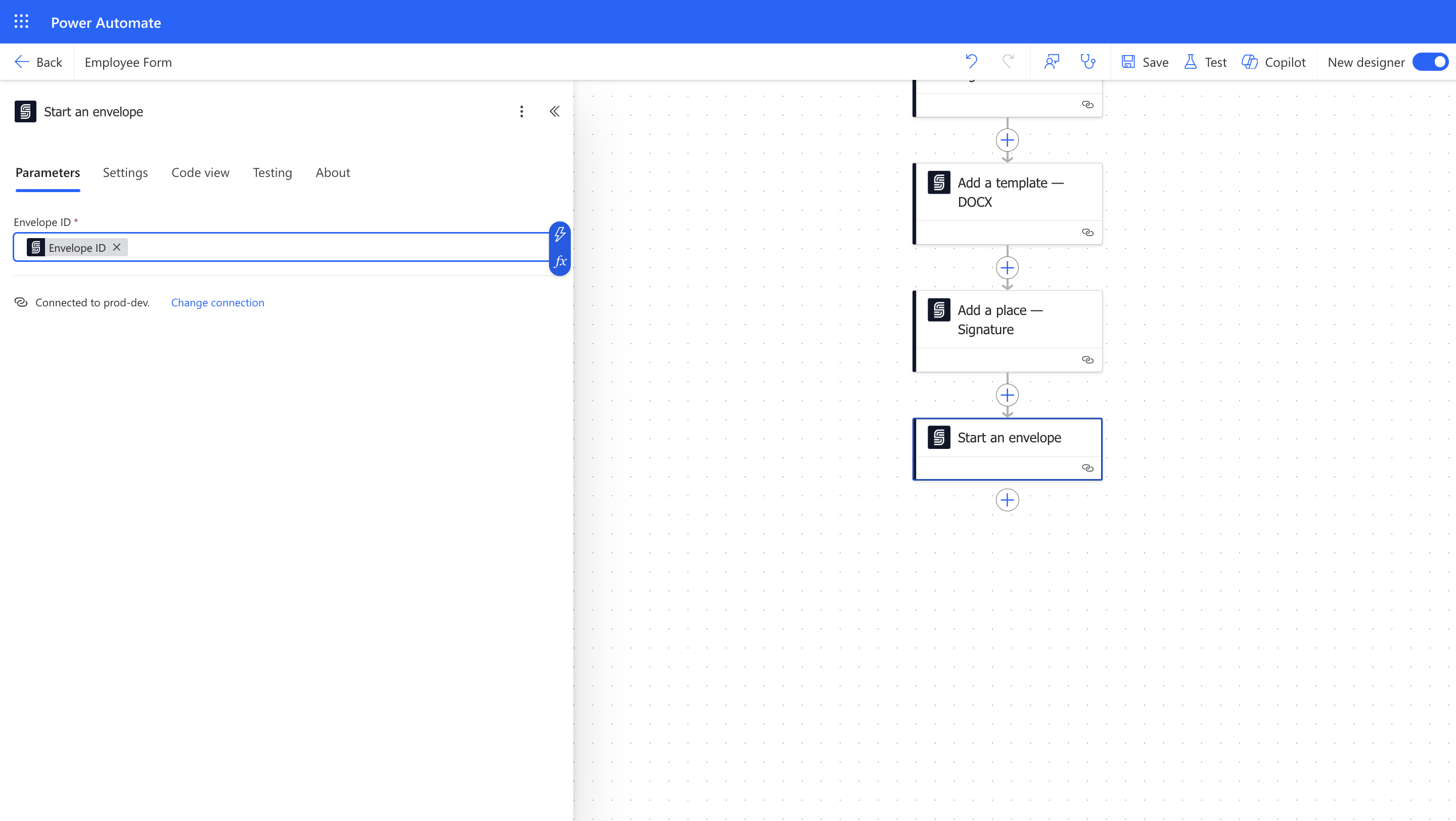
Send your envelope to the employee for signing.- Add the Start Envelope action.
-
Select the appropriate Envelope ID using dynamic content.
Step 5: Monitor and Finalize the Contract
Configure your flow to wait for the signing to complete, retrieve the signed contract, and notify HR.5.1 Wait for Signature Completion
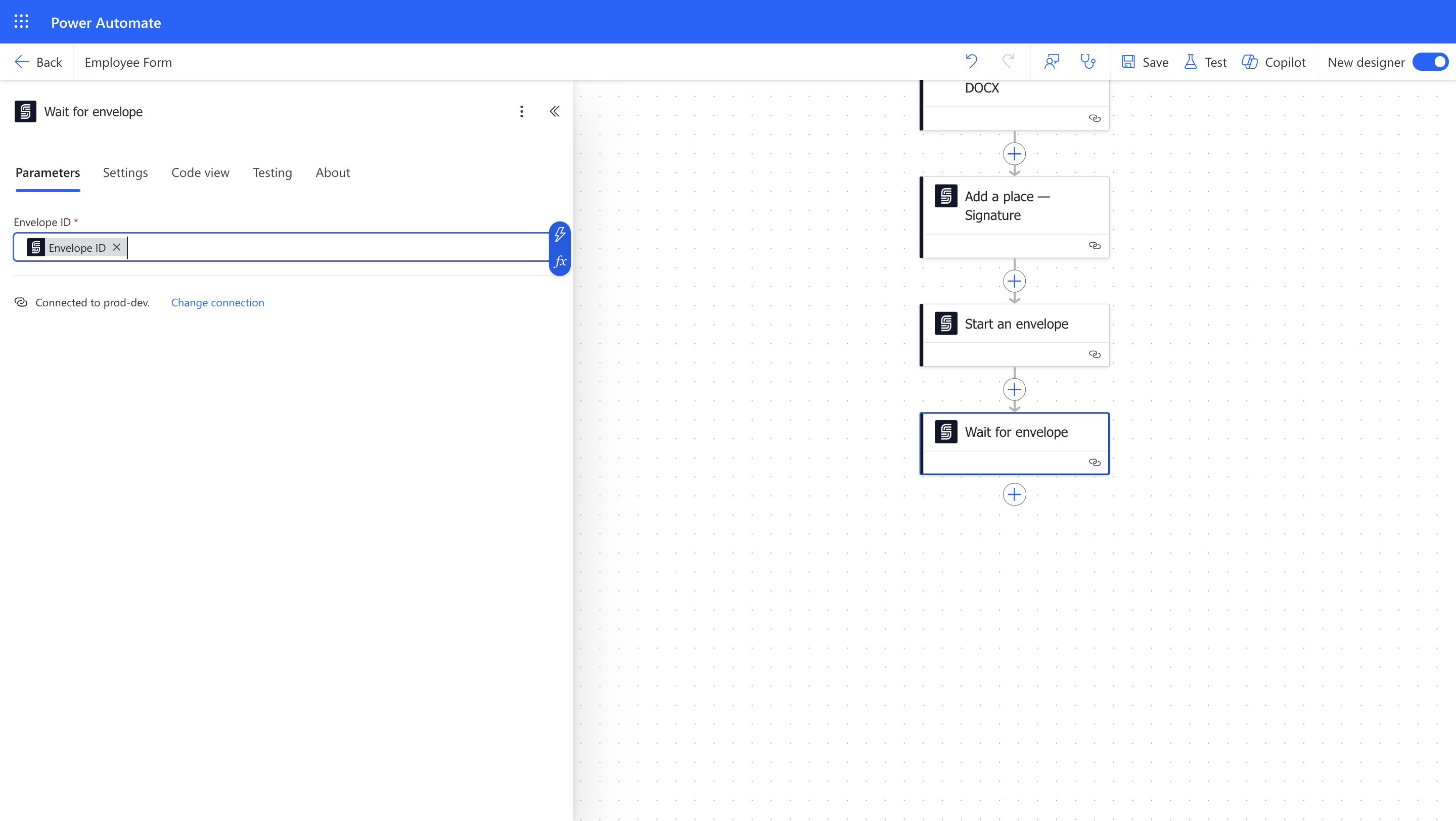
Pause the flow until the employee signs the contract.- Add the Wait for Envelope Completion action.
-
Select the correct Envelope ID using dynamic content.
5.2 Retrieve the Signed Contract
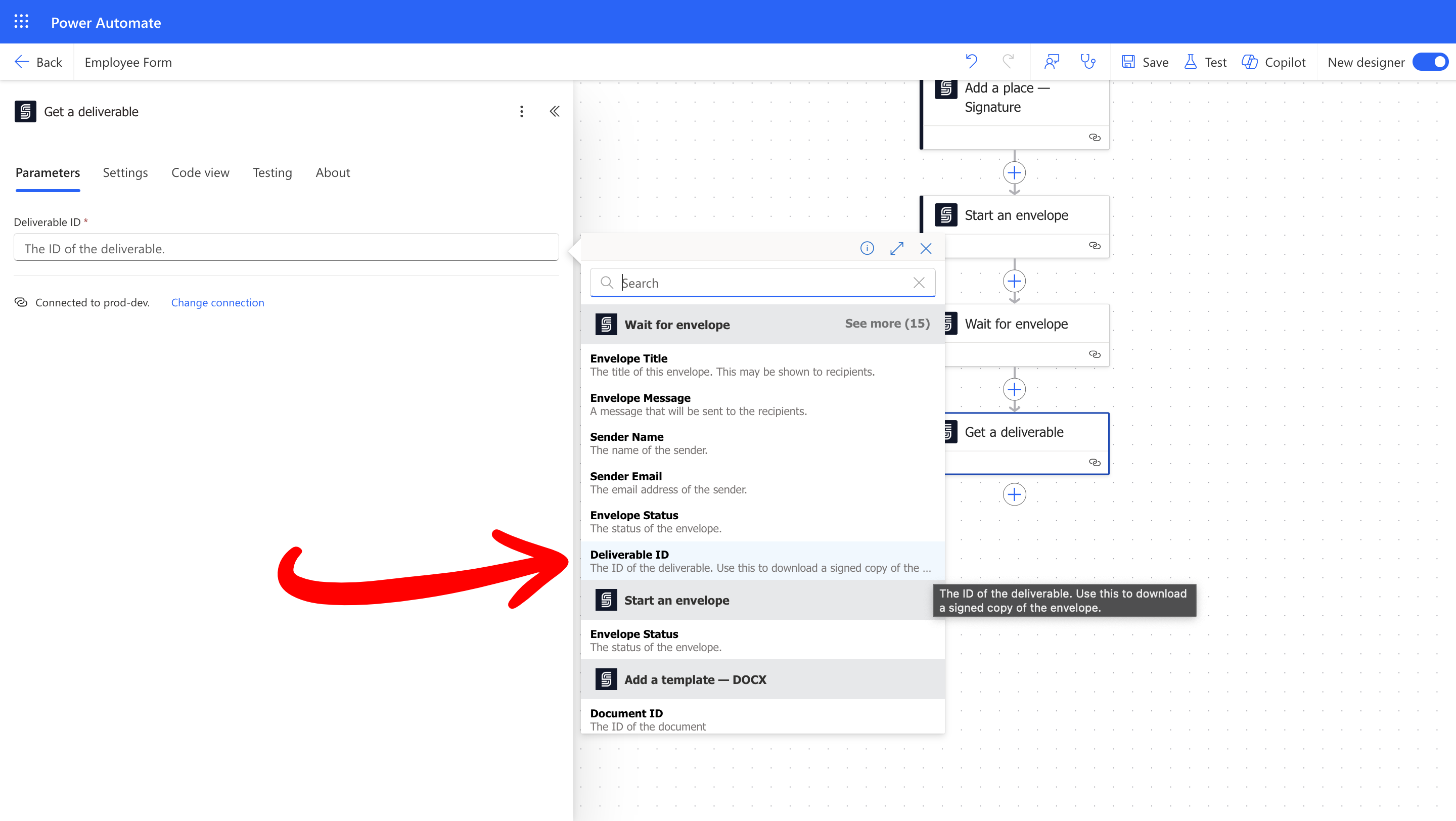
Once signed, automatically retrieve the completed document.- Add the Get a Deliverable action.
-
Select the correct Deliverable ID using dynamic content.
5.3 Save the Signed Contract to OneDrive
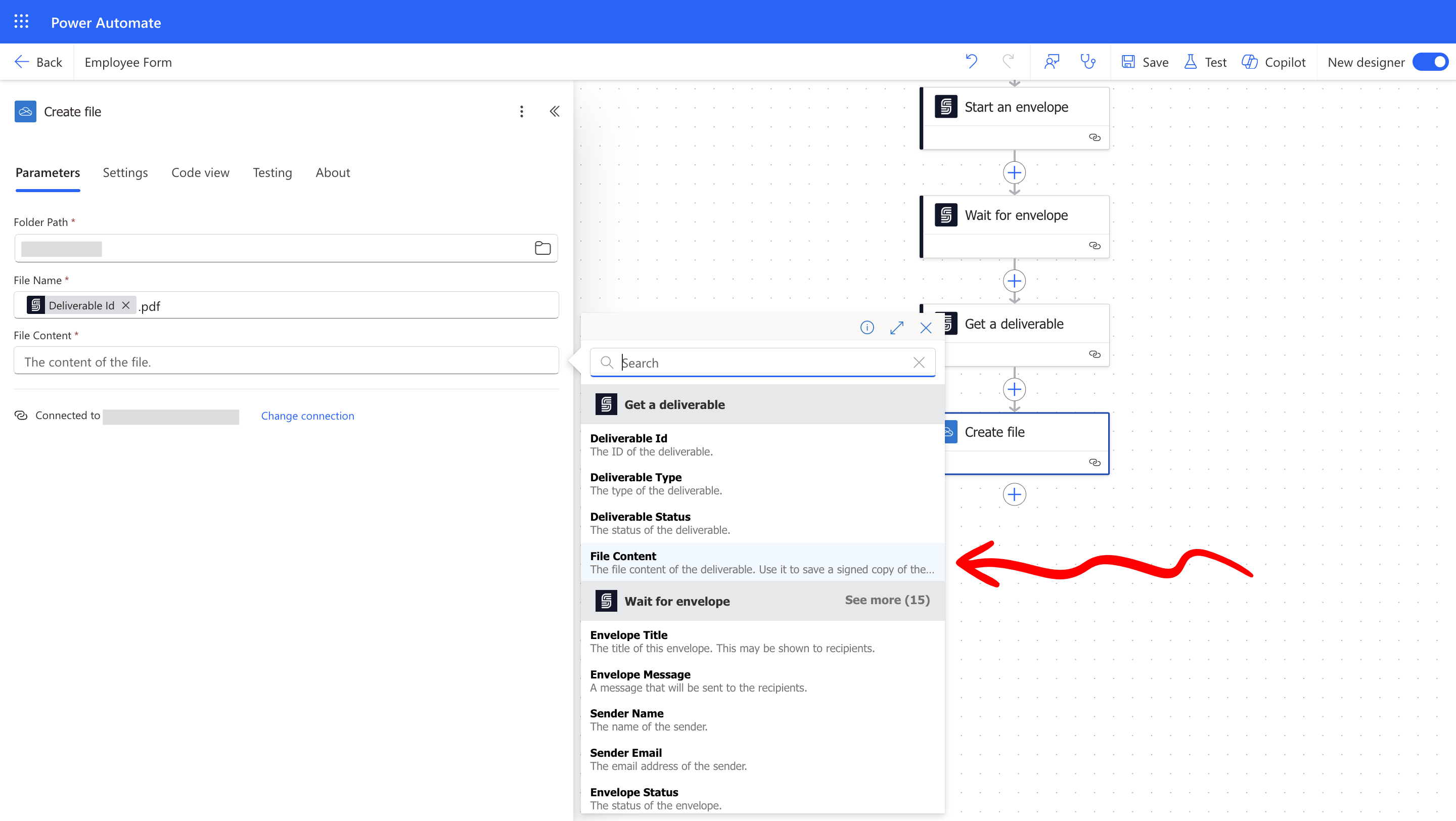
Save the signed document for record-keeping.- Add the Create File action (OneDrive connector).
-
Set the folder path and filename (ending in
.pdf). -
Map File Content from the deliverable.
5.4 Notify HR via Email
Automatically inform HR that the contract has been signed and saved.- Add the Send an Email action (Outlook connector).
- Configure the email recipient (HR), subject, and message.
-
Attach the signed contract file from dynamic content. Use the File Content from the Get a Deliverable action, and set the filename (ending in
.pdf).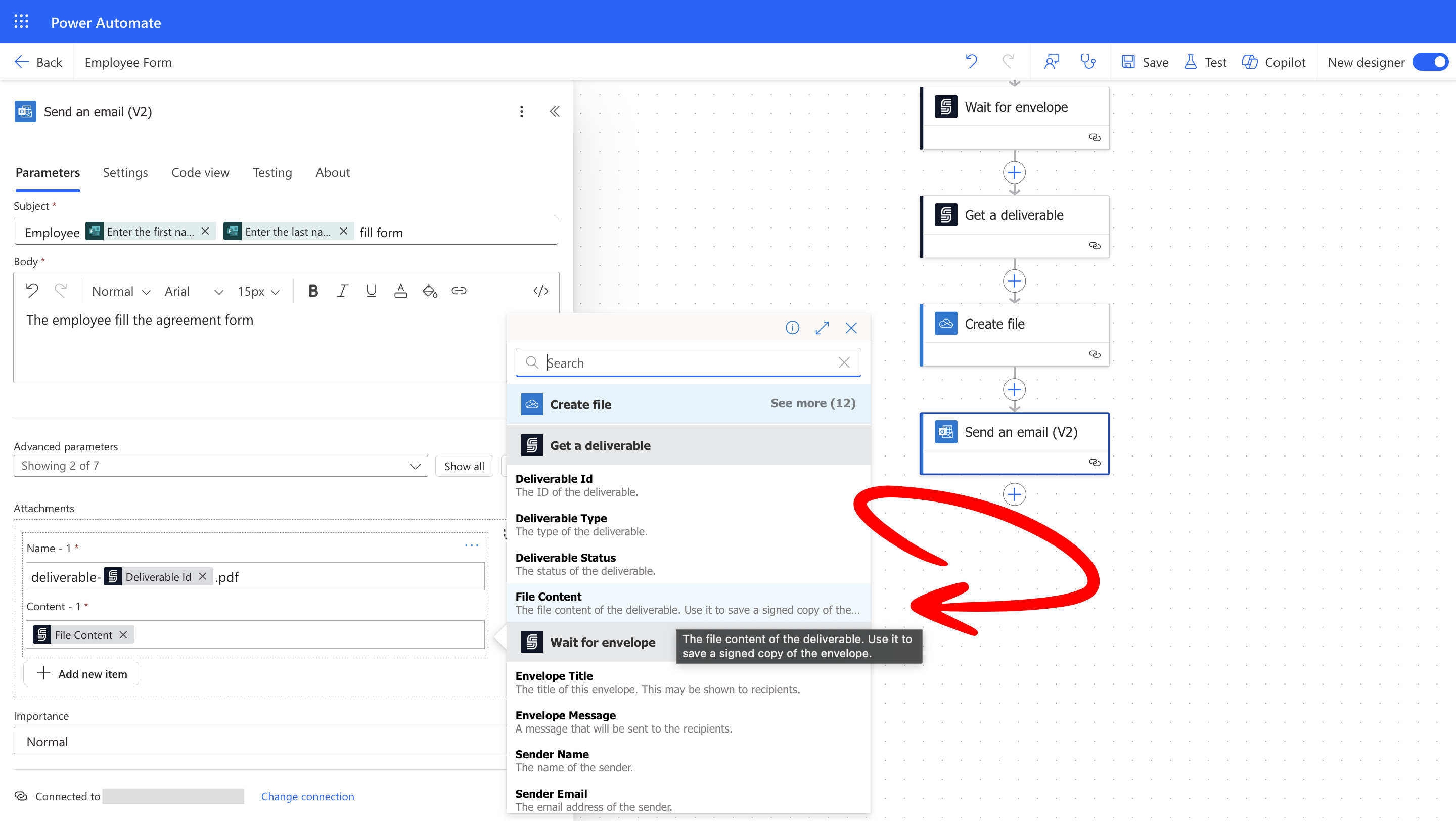
Step 6: Test Your Automation
Finally, test the entire process end-to-end.- Save your Power Automate flow.
- Submit a test response through your Microsoft Form.
- Verify:
- Contract is sent to the employee.
- Signature process initiates correctly.
- Signed contract saves successfully in OneDrive.
- HR receives an email notification with the signed contract attached.
- Contract sent successfully.
- Employee receives and signs contract.
- Signed document stored correctly in OneDrive.
- HR receives email notification with attachment.
Troubleshooting & FAQ
Common Issues
- API Key Errors: Ensure your SignatureAPI key is correct and authenticated.
- Dynamic Content Mapping: Double-check that placeholder names in your DOCX file match exactly with dynamic content mappings in Power Automate.
- File Access Issues: Verify permissions and file paths in OneDrive.
Frequently Asked Questions
- What if the contract is not sent? Check your SignatureAPI dashboard for errors, and verify the recipient details are mapped correctly from the form response.
- Can I adapt this for other document types? Yes. This method works for any automated document-signing workflow, such as NDAs, vendor agreements, or offer letters.
-
Can I collect additional fields in Microsoft Forms and use them in my contract template?
Yes. Add new questions to your Microsoft Form, then insert matching placeholders (e.g.,
{{employee.department}}) in your DOCX template. In the Add a Template - DOCX action, map each new placeholder to the corresponding form response using Dynamic Content.
Best Practices & Security
- Always securely manage API keys.
- Regularly check flow runs in Power Automate for any errors.
- Document any flow or template changes for future reference.