> ## Documentation Index
> Fetch the complete documentation index at: https://signatureapi-daf4ee54.mintlify.site/llms.txt
> Use this file to discover all available pages before exploring further.
# Use Placeholders to Position Signatures
> Position signature fields dynamically using text placeholders embedded in your documents
In SignatureAPI, [places](/docs/api/resources/places/object) are areas in a document where recipients sign, enter information, or where details, such as dates, are automatically added. The [signature place](/docs/api/resources/places/signature) is one of such places.
There are two ways to position places: [fixed positions](/docs/api/resources/places/signature#fixed-positions) (coordinates) and [placeholders](/docs/api/resources/places/signature#placeholders) within the document. In this example, we will show how to position a **signature place** using a **placeholder**.
For this example, we will create an envelope with:
* One recipient (of type `signer`), identified with the key `visitor`.
* The visitor signs a single PDF document.
* The document will have one signature place, identified with the key `signer_signs_here`, that will be signed by the recipient `visitor`.
All other envelope settings use the default configuration:
* The recipient will receive an email with a link to sign.
* The account's default language, timezone, and timestamp format used.
## Prepare your Document
Placeholders are text within your PDF document that define the location where places (such as signatures, initials, text inputs, etc.) should appear. They follow the format `[[place_key]]`, where `place_key` identifies the place within the document.
Place placeholders use double brackets: `[[place_key]]`. Template fields use double curly braces (`{{field_key}}`) to inject content into DOCX documents. A DOCX document can use both. See [Document Templates](/docs/api/resources/documents/templates) for template fields.
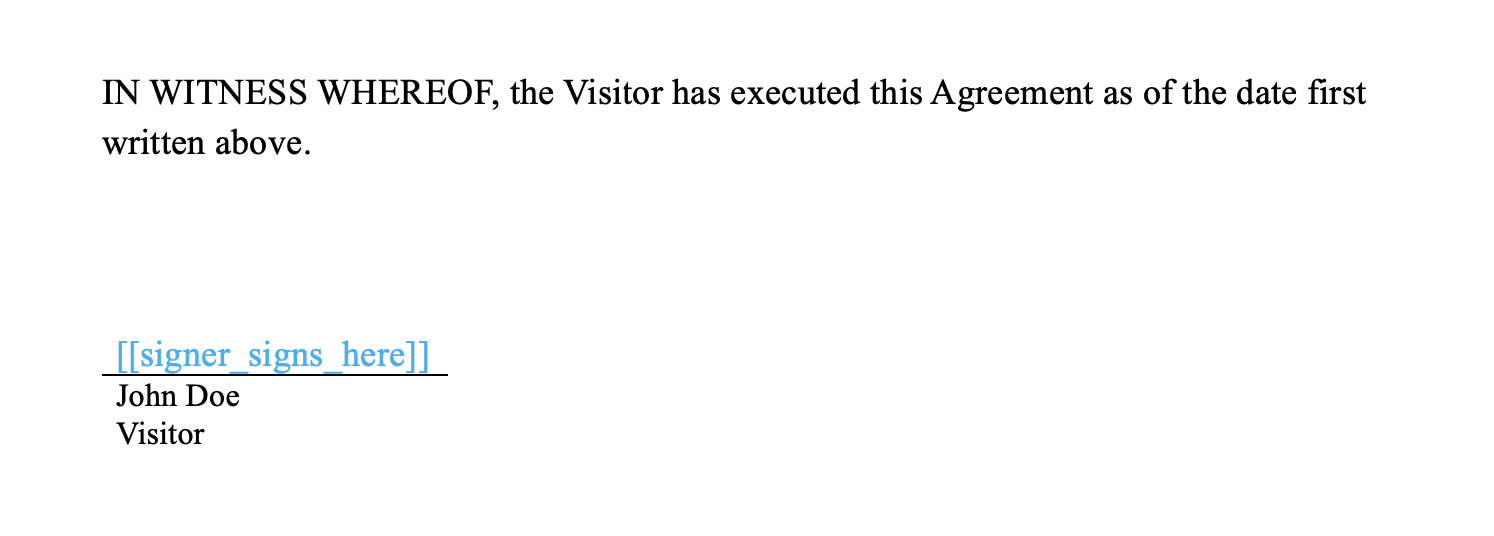
For this example, we prepared a document that contains the placeholder `[[signer_signs_here]]` to indicate the position of the place with the key `signer_signs_here`.
Download the PDF used in this example.
In our document, the placeholder is highlighted in blue for visibility. However, we recommend setting it to white so it remains invisible to the signer.
 ## Create the Envelope
When creating the envelope, add the signature place object to the `places` array inside the document object, with the following properties:
* `key`: This identifies the place within the document. Must match what’s inside the square brackets in the placeholder inside the document file, in this case: `signer_signs_here`.
* `type`: As this is a signature place, we use the value `signature`.
* `recipient_key`: The key of the recipient that will sign in this place. In this example, there is just one recipient, who has the key `visitor`.
```json theme={null}
// POST https://api.signatureapi.com/v1/envelopes
// X-Api-Key:
{
"title": "Dummy Consent",
"message": "Please review and sign the Dummy Privacy Policy for internal testing purposes. This document is not legally binding and is used solely for demonstration\n\nThank you for your cooperation.",
"documents": [
{
"url": "https://pub-9cb75390636c4a8a83a6f76da33d7f45.r2.dev/privacy-placeholder.pdf",
"places": [
{
"key": "signer_signs_here",
"type": "signature",
"recipient_key": "visitor"
}
]
}
],
"recipients": [
{
"type": "signer",
"key": "visitor",
"name": "John Doe",
"email": "john@example.com"
}
]
}
```
## Result
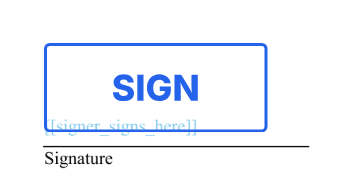
If the request is successful, SignatureAPI will send John Doe (the recipient) an email with a link to sign. John will click the link and will be able to place his signature on top of the signature line.
## Create the Envelope
When creating the envelope, add the signature place object to the `places` array inside the document object, with the following properties:
* `key`: This identifies the place within the document. Must match what’s inside the square brackets in the placeholder inside the document file, in this case: `signer_signs_here`.
* `type`: As this is a signature place, we use the value `signature`.
* `recipient_key`: The key of the recipient that will sign in this place. In this example, there is just one recipient, who has the key `visitor`.
```json theme={null}
// POST https://api.signatureapi.com/v1/envelopes
// X-Api-Key:
{
"title": "Dummy Consent",
"message": "Please review and sign the Dummy Privacy Policy for internal testing purposes. This document is not legally binding and is used solely for demonstration\n\nThank you for your cooperation.",
"documents": [
{
"url": "https://pub-9cb75390636c4a8a83a6f76da33d7f45.r2.dev/privacy-placeholder.pdf",
"places": [
{
"key": "signer_signs_here",
"type": "signature",
"recipient_key": "visitor"
}
]
}
],
"recipients": [
{
"type": "signer",
"key": "visitor",
"name": "John Doe",
"email": "john@example.com"
}
]
}
```
## Result
If the request is successful, SignatureAPI will send John Doe (the recipient) an email with a link to sign. John will click the link and will be able to place his signature on top of the signature line.
 ## Try It
[Try this example in Postman](/docs/api/postman) using your [test API key](/docs/api/test-mode) to create a free, non-binding test envelope. Test envelopes won't send emails, but you can review them in your dashboard.
## Keep Learning
* Learn how to position a signature using [coordinates](/docs/api/guides/how-to/use-fixed-positions) when exact positioning is required.
* Explore other [types of places](/docs/api/resources/places/object), such as [initials](/docs/api/resources/places/initials), [text inputs](/docs/api/resources/places/text-input), or [completion dates](/docs/api/resources/places/date).
## Try It
[Try this example in Postman](/docs/api/postman) using your [test API key](/docs/api/test-mode) to create a free, non-binding test envelope. Test envelopes won't send emails, but you can review them in your dashboard.
## Keep Learning
* Learn how to position a signature using [coordinates](/docs/api/guides/how-to/use-fixed-positions) when exact positioning is required.
* Explore other [types of places](/docs/api/resources/places/object), such as [initials](/docs/api/resources/places/initials), [text inputs](/docs/api/resources/places/text-input), or [completion dates](/docs/api/resources/places/date).